China’s photovoltaic industry is no longer judged by module output alone. Behind each panel stands a network of Photovoltaic Accessories, including mounting rails, cable connectors, junction boxes, fuses, clamps, trackers, and monitoring devices. These components influence installation speed, electrical safety, weather resistance, and long-term maintenance. A weak connector can create heat at a rooftop. A poorly finished clamp can loosen under wind and rain.
This article examines China’s top 10 Photovoltaic Accessories manufacturers through practical criteria. Product consistency matters. So do certification records, material traceability, testing capacity, export experience, and after-sales support. Factory scale can be impressive, but scale does not guarantee reliable field performance. That is an uncomfortable point.
Jenny Chase, a widely respected solar-market analyst, has said, “Solar is increasingly a manufacturing and supply-chain story.” Her observation fits accessories particularly well. A project may use premium modules, yet still suffer from fragile cables or unsuitable mounting hardware. The smallest parts can become the largest risks.
The companies featured here represent different strengths. Some focus on aluminum structures. Others specialize in connectors, trackers, or protection equipment. Their real value should be tested against installation conditions, not attractive brochures. Coastal salt, desert dust, freezing winters, and rooftop movement all expose different weaknesses. Rankings can also change as certification, pricing, and technology develop. Readers should verify current product documents before making procurement decisions. This list is a starting point, not a final verdict.
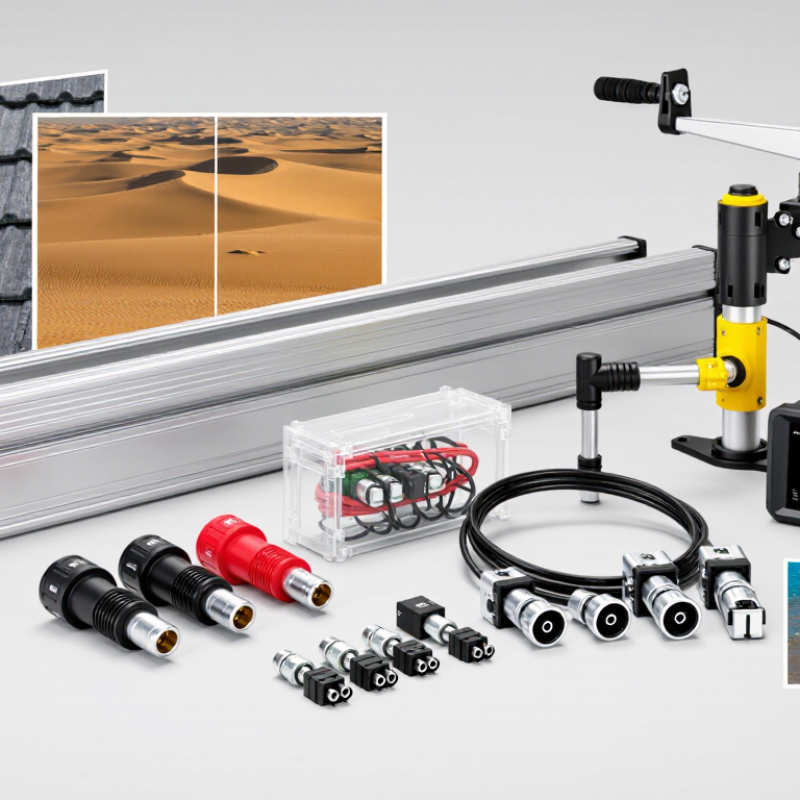
China’s top photovoltaic accessories manufacturers produce the components that keep a solar energy system safe, stable, and serviceable. These accessories include mounting rails, brackets, clamps, cable connectors, junction boxes, fuses, surge protectors, and monitoring devices. In larger projects, installers also need grounding kits, cable trays, combiner boxes, and inverter communication equipment. Each part has a practical role.
A reliable manufacturer should provide clear technical drawings, material certificates, load data, and inspection records. Aluminum mounting parts must resist corrosion and support local wind loads. Cables and connectors need suitable voltage, temperature, and waterproof ratings. In field inspections, small mismatches often cause delays. A connector may look compatible but fail under heat or moisture. That detail matters.
Tips:
Check every accessory against the inverter, module, and installation environment. Confirm connector compatibility before delivery. Ask for sample testing and traceable quality reports. Do not choose only by price. A cheaper clamp can deform, while weak cable protection may increase maintenance work. I have found that packaging also deserves attention, because damaged terminals can create hidden risks. Specifications are helpful, but they are not perfect. Site conditions may expose gaps in the original design. Leave room for professional review, especially on rooftops, coastal sites, and large ground-mounted systems.
China’s photovoltaic accessories sector deserves careful screening, not a popularity contest. IEA PVPS Trends 2024 reports that global solar capacity exceeded 1.6 terawatts after about 447 gigawatts of new installations in 2023. This scale increases demand for connectors, mounting systems, junction boxes, cables, and monitoring components. It also exposes weak suppliers quickly.
Evaluate each manufacturer through traceable evidence. Check factory ownership, production history, export records, and testing capacity. Request recent certificates for IEC standards, material declarations, and electrical safety tests. Do not accept a certificate alone. Match its model number, issuing laboratory, validity period, and test scope. IRENA’s Renewable Capacity Statistics 2024 recorded strong worldwide expansion, but its data also reminds buyers that installation growth does not guarantee component quality.
Inspect samples under realistic conditions. Look for clean crimping, consistent metal thickness, sealed cable glands, and readable laser markings. Ask for temperature-cycle, salt-spray, UV-aging, and load-test results. A serious supplier should explain failure rates and corrective actions, even when the answer is uncomfortable. Factory audits should include incoming-material records and random warehouse checks. Video tours are useful, but insufficient.
Price needs context. A lower quotation may hide thinner aluminum, unstable polymers, weak traceability, or limited warranty support. Compare total installed cost, replacement risk, lead time, and after-sales response. Some evaluations remain imperfect because reported data can be selective. Independent testing and small pilot orders reduce that uncertainty. Check performance again after six months.
A practical, standards-based evaluation scorecard for comparing photovoltaic accessory manufacturers
| No. | Evaluation Dimension | Recommended Screening Benchmark | Relevant Standard or Evidence | Why It Matters | Verification Method |
|---|---|---|---|---|---|
| 1 | Product Coverage | At least two relevant photovoltaic accessory categories, such as mounting systems, DC cables, connectors, junction boxes, trackers, or monitoring equipment. | Published product catalogue, technical datasheets, and product-specific certifications. | A broader product portfolio can simplify procurement and improve system compatibility. | Request a current catalogue, product drawings, and a compatibility matrix. |
| 2 | Quality Management | An active ISO 9001 quality-management certificate covering the relevant manufacturing site. | ISO 9001 certificate with valid scope, issuing body, site address, and expiry date. | Demonstrates documented controls for purchasing, production, inspection, and corrective action. | Check the certificate number with the issuing certification body. |
| 3 | Product-Specific Compliance | Compliance evidence matched to the product type rather than a generic company certificate. | Examples include IEC 62852 for photovoltaic connectors, IEC 62790 for module junction boxes, and IEC 62930 or EN 50618 for photovoltaic cables. | Product-specific testing addresses electrical, mechanical, environmental, and fire-safety risks. | Obtain the complete test report and confirm that model numbers match the quotation. |
| 4 | Material Traceability | Lot or batch identification for key materials, including metals, polymers, cable conductors, terminals, and sealing components. | Raw-material certificates, incoming inspection records, production batch codes, and final inspection reports. | Traceability enables faster root-cause analysis and targeted product recalls. | Perform a sample traceability exercise from finished goods back to raw materials. |
| 5 | Environmental Resistance | Documented resistance appropriate for the project location, including UV exposure, humidity, temperature cycling, corrosion, and water ingress. | IEC 60529 ingress-protection rating where applicable, environmental test reports, and corrosion-test documentation. | Outdoor photovoltaic accessories operate for many years under changing weather conditions. | Compare test conditions with the site’s temperature, humidity, wind, salt, and pollution profile. |
| 6 | Electrical and Mechanical Ratings | Published voltage, current, temperature, load, wind, snow, and installation limits with an appropriate engineering safety margin. | Technical datasheets, design calculations, load-test reports, and product drawings. | Correct ratings reduce the risk of overheating, structural failure, arcing, and premature degradation. | Have an independent engineer review the ratings against the project design conditions. |
| 7 | Warranty and After-Sales Support | A written warranty specifying duration, covered defects, exclusions, claim procedures, replacement terms, and response times. | Signed warranty document and documented technical-support process. | Clear warranty terms make long-term risk and total ownership cost easier to assess. | Review exclusions carefully and request anonymized records of previous warranty cases. |
| 8 | Production Capacity and Lead Time | Capacity and lead-time commitments supported by production planning, available equipment, and recent delivery records. | Production schedule, capacity statement, factory audit, and on-time delivery history. | Reliable supply is essential for large projects with fixed installation milestones. | Compare quoted lead times with purchase-order history and inspect actual production lines. |
| 9 | Export and Documentation Capability | Complete English documentation, export packaging procedures, commercial documents, and experience with the destination market’s requirements. | Packing lists, certificates of origin, inspection documents, installation manuals, and shipping records. | Accurate documentation reduces customs delays, installation errors, and compliance disputes. | Request a complete sample document package before placing an order. |
| 10 | Factory Audit and Financial Reliability | Verified manufacturing location, stable ownership information, transparent payment terms, and satisfactory independent factory-audit results. | Business registration, site audit, production photographs, customer references, and audited commercial records where available. | Reduces supplier, continuity, counterfeit, and payment-related risks. | Use an independent inspection agency and verify the legal entity receiving payment. |
Note: Certification requirements depend on the accessory type, destination market, project design, and applicable regulations. Certificates should always be verified for the specific manufacturing site, product model, and current validity period.
China’s Top 10 Photovoltaic Accessories Manufacturers deserve attention because accessories influence safety, efficiency, and long-term maintenance. The strongest manufacturers usually produce mounting structures, junction boxes, connectors, cables, combiner boxes, and monitoring components. Their products must withstand ultraviolet exposure, coastal salt, heavy rain, and repeated temperature changes.
A reliable evaluation should examine material certificates, factory testing, production consistency, and after-sales support. For mounting systems, engineers should check aluminum strength, fastener quality, drainage design, and wind-load calculations. For electrical accessories, insulation performance, contact resistance, sealing, and thermal behavior matter greatly. Field experience also reveals small problems, such as brittle cable jackets or poorly fitted connectors. These details can increase maintenance costs.
The ranking is not absolute.
A manufacturer may perform well in utility-scale projects but offer limited support for smaller installations. Another may provide strong customization but slower delivery. Buyers should request test reports, sample inspections, warranty terms, and traceable quality records. Independent verification is useful when project conditions are complex. Price alone remains a weak indicator. I have seen low-cost accessories create repeated faults after harsh weather, although one inspection cannot represent every production batch. China’s top ten manufacturers should therefore be compared through measurable evidence, application suitability, and proven field performance rather than marketing claims.
China’s top ten photovoltaic accessories manufacturers typically serve different parts of a solar installation. Their key products include mounting rails, roof hooks, mid clamps, end clamps, cable connectors, junction boxes, grounding devices, and tracking components. Some also supply complete racking systems for factories and utility-scale projects. Their strengths often lie in aluminum processing, precise molding, corrosion resistance, and large-volume production. Strong manufacturers provide stable dimensions, clear installation instructions, and traceable material records.
Tips: Check load calculations, metal thickness, connector compatibility, and weather testing before ordering. Request sample units. A small sample can reveal loose threads, sharp edges, or weak seals. Confirm testing reports and relevant market certifications through independent documents, not only sales claims.
Product strength should match the project environment. Coastal sites need stronger corrosion protection, while snowy regions require higher mechanical load ratings. Cable accessories must fit the selected conductor size and insulation type. Leading suppliers often support custom packaging, technical drawings, and delivery planning. Still, no supplier is perfect. A low price may hide thinner metal or inconsistent batches. Even polished catalogs can miss practical installation problems. Inspecting a pilot shipment and recording field feedback remains a reliable purchasing habit.
Choosing a Chinese photovoltaic accessories supplier requires more than comparing prices. Check the supplier’s actual product range, production capacity, and quality-control process. Ask for recent test reports, material specifications, and traceability records for cables, connectors, junction boxes, and mounting parts. Verify certificates through the issuing organization, not only through a sales brochure. A reliable supplier should explain testing methods clearly and provide stable technical support after delivery.
Tips: Request samples from the same production line used for bulk orders. Compare connector fit, cable flexibility, sealing quality, and labeling accuracy. Confirm minimum order quantities, lead times, packaging details, warranty terms, and replacement procedures in writing. A factory tour can help, but it is not conclusive. Polished showrooms sometimes hide weak inspection systems.
Evaluate communication as carefully as the products. Suppliers should answer technical questions directly and identify product limitations honestly. Check whether their accessories match your module dimensions, inverter requirements, installation environment, and local standards. Independent inspection before shipment can reduce avoidable risks. Still, no checklist is perfect. Begin with a small order, monitor defects, and review delivery performance before expanding cooperation. Clear records matter.
Common parts include mounting rails, brackets, clamps, connectors, junction boxes, fuses, and surge protectors. Larger projects may need grounding kits, cable trays, combiner boxes, and communication equipment. Each component supports safety, installation, or maintenance.
Compare every accessory with the modules, inverter, cable size, and installation environment. Confirm connector type, voltage rating, temperature rating, and waterproof protection. Visual similarity is not enough. A connector may fit poorly after heat or moisture exposure.
Request technical drawings, material certificates, load data, inspection records, and test reports. Ask for traceable quality records. Verify certificates through the issuing organization. Sales documents alone may not prove product quality.
Coastal projects need stronger corrosion protection for metal parts and connectors. Snowy areas require higher mechanical load ratings. Roof systems also need accurate wind-load calculations. Local conditions can expose design gaps.
Samples can reveal loose threads, sharp edges, weak seals, or poor cable flexibility. Check whether connectors lock firmly. Inspect labels and dimensions. A small sample cannot reveal everything, but it reduces avoidable surprises.
Poor packaging may bend terminals, scratch metal parts, or damage connector seals. Inspect cartons when they arrive. Photograph damaged items immediately. Packaging seems minor. It can create hidden risks during installation.
Compare production capacity, product range, quality controls, delivery records, and technical support. Review minimum order quantities, lead times, warranty terms, and replacement procedures. Use independent inspection before shipment when practical. A polished factory showroom is not conclusive.
Not usually. A low price may reflect thinner metal, inconsistent batches, or weak cable protection. Check material thickness, sealing quality, and load performance instead. No supplier or checklist is perfect. Start with a small order and review field results before expanding cooperation.
Photovoltaic Accessories are essential components of a solar energy system, supporting safe installation, efficient power transmission, reliable protection, and long-term performance. This overview explains how accessories such as mounting structures, connectors, cables, junction boxes, fuses, circuit breakers, monitoring devices, and grounding equipment work together. It also introduces practical criteria for evaluating Chinese manufacturers, including product quality, material durability, technical certifications, production capacity, customization services, delivery reliability, and after-sales support.
The discussion presents China’s top 10 Photovoltaic Accessories manufacturers as a general industry selection, focusing on their key product categories and competitive strengths without promoting specific brands. It also offers guidance for choosing the right supplier according to project size, climate, system design, budget, compliance requirements, and installation conditions. By comparing technical specifications, testing standards, communication efficiency, warranty policies, and total purchasing costs, solar developers and distributors can identify dependable partners and build photovoltaic systems that are safer, more efficient, and easier to maintain.

Bangzhao Electric